Obama is Jimmy Carter. No doubt about it.
We need to find our Ronald Reagan.

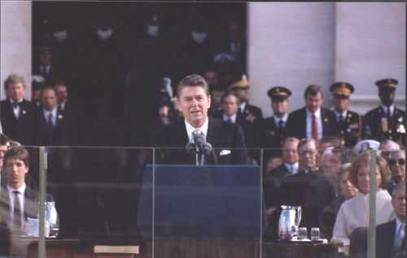
We're here to mark that day in history when the Allied armies joined in battle to reclaim this continent to liberty. For four long years, much of Europe had been under a terrible shadow. Free nations had fallen, Jews cried out in the camps, millions cried out for liberation. Europe was enslaved and the world prayed for its rescue. Here, in Normandy, the rescue began. Here, the Allies stood and fought against tyranny, in a giant undertaking unparalleled in human history.
We stand on a lonely, windswept point on the northern shore of France. The air is soft, but forty years ago at this moment, the air was dense with smoke and the cries of men, and the air was filled with the crack of rifle fire and the roar of cannon. At dawn, on the morning of the 6th of June, 1944, two hundred and twenty-five Rangers jumped off the British landing craft and ran to the bottom of these cliffs.
Their mission was one of the most difficult and daring of the invasion: to climb these sheer and desolate cliffs and take out the enemy guns. The Allies had been told that some of the mightiest of these guns were here, and they would be trained on the beaches to stop the Allied advance.
The Rangers looked up and saw the enemy soldiers at the edge of the cliffs, shooting down at them with machine guns and throwing grenades. And the American Rangers began to climb. They shot rope ladders over the face of these cliffs and began to pull themselves up. When one Ranger fell, another would take his place. When one rope was cut, a Ranger would grab another and begin his climb again. They climbed, shot back, and held their footing. Soon, one by one, the Rangers pulled themselves over the top, and in seizing the firm land at the top of these cliffs, they began to seize back the continent of Europe. Two hundred and twenty-five came here. After two days of fighting, only ninety could still bear arms.
And behind me is a memorial that symbolizes the Ranger daggers that were thrust into the top of these cliffs. And before me are the men who put them there. These are the boys of Pointe du Hoc. These are the men who took the cliffs. These are the champions who helped free a continent. And these are the heroes who helped end a war. Gentlemen, I look at you and I think of the words of Stephen Spender's poem. You are men who in your "lives fought for life and left the vivid air signed with your honor."
I think I know what you may be thinking right now -- thinking "we were just part of a bigger effort; everyone was brave that day." Well everyone was. Do you remember the story of Bill Millin of the 51st Highlanders? Forty years ago today, British troops were pinned down near a bridge, waiting desperately for help. Suddenly, they heard the sound of bagpipes, and some thought they were dreaming. Well, they weren't. They looked up and saw Bill Millin with his bagpipes, leading the reinforcements and ignoring the smack of the bullets into the ground around him.
Lord Lovat was with him -- Lord Lovat of Scotland, who calmly announced when he got to the bridge, "Sorry, I'm a few minutes late," as if he'd been delayed by a traffic jam, when in truth he'd just come from the bloody fighting on Sword Beach, which he and his men had just taken.
There was the impossible valor of the Poles, who threw themselves between the enemy and the rest of Europe as the invasion took hold; and the unsurpassed courage of the Canadians who had already seen the horrors of war on this coast. They knew what awaited them there, but they would not be deterred. And once they hit Juno Beach, they never looked back.
All of these men were part of a roll call of honor with names that spoke of a pride as bright as the colors they bore; The Royal Winnipeg Rifles, Poland's 24th Lancers, the Royal Scots' Fusiliers, the Screaming Eagles, the Yeomen of England's armored divisions, the forces of Free France, the Coast Guard's "Matchbox Fleet," and you, the American Rangers.
Forty summers have passed since the battle that you fought here. You were young the day you took these cliffs; some of you were hardly more than boys, with the deepest joys of life before you. Yet you risked everything here. Why? Why did you do it? What impelled you to put aside the instinct for self-preservation and risk your lives to take these cliffs? What inspired all the men of the armies that met here? We look at you, and somehow we know the answer. It was faith and belief. It was loyalty and love.
The men of Normandy had faith that what they were doing was right, faith that they fought for all humanity, faith that a just God would grant them mercy on this beachhead, or on the next. It was the deep knowledge -- and pray God we have not lost it -- that there is a profound moral difference between the use of force for liberation and the use of force for conquest. You were here to liberate, not to conquer, and so you and those others did not doubt your cause. And you were right not to doubt.
You all knew that some things are worth dying for. One's country is worth dying for, and democracy is worth dying for, because it's the most deeply honorable form of government ever devised by man. All of you loved liberty. All of you were willing to fight tyranny, and you knew the people of your countries were behind you.
The Americans who fought here that morning knew word of the invasion was spreading through the darkness back home. They fought -- or felt in their hearts, though they couldn't know in fact, that in Georgia they were filling the churches at 4:00 am. In Kansas they were kneeling on their porches and praying. And in Philadelphia they were ringing the Liberty Bell.
Something else helped the men of D-day; their rock-hard belief that Providence would have a great hand in the events that would unfold here; that God was an ally in this great cause. And so, the night before the invasion, when Colonel Wolverton asked his parachute troops to kneel with him in prayer, he told them: "Do not bow your heads, but look up so you can see God and ask His blessing in what we're about to do." Also, that night, General Matthew Ridgway on his cot, listening in the darkness for the promise God made to Joshua: "I will not fail thee nor forsake thee."
These are the things that impelled them; these are the things that shaped the unity of the Allies.
When the war was over, there were lives to be rebuilt and governments to be returned to the people. There were nations to be reborn. Above all, there was a new peace to be assured. These were huge and daunting tasks. But the Allies summoned strength from the faith, belief, loyalty, and love of those who fell here. They rebuilt a new Europe together. There was first a great reconciliation among those who had been enemies, all of whom had suffered so greatly. The United States did its part, creating the Marshall Plan to help rebuild our allies and our former enemies. The Marshall Plan led to the Atlantic alliance -- a great alliance that serves to this day as our shield for freedom, for prosperity, and for peace.
In spite of our great efforts and successes, not all that followed the end of the war was happy or planned. Some liberated countries were lost. The great sadness of this loss echoes down to our own time in the streets of Warsaw, Prague, and East Berlin. The Soviet troops that came to the center of this continent did not leave when peace came. They're still there, uninvited, unwanted, unyielding, almost forty years after the war. Because of this, allied forces still stand on this continent. Today, as forty years ago, our armies are here for only one purpose: to protect and defend democracy. The only territories we hold are memorials like this one and graveyards where our heroes rest.
We in America have learned bitter lessons from two world wars. It is better to be here ready to protect the peace, than to take blind shelter across the sea, rushing to respond only after freedom is lost. We've learned that isolationism never was and never will be an acceptable response to tyrannical governments with an expansionist intent. But we try always to be prepared for peace, prepared to deter aggression, prepared to negotiate the reduction of arms, and yes, prepared to reach out again in the spirit of reconciliation. In truth, there is no reconciliation we would welcome more than a reconciliation with the Soviet Union, so, together, we can lessen the risks of war, now and forever.
It's fitting to remember here the great losses also suffered by the Russian people during World War II. Twenty million perished, a terrible price that testifies to all the world the necessity of ending war. I tell you from my heart that we in the United States do not want war. We want to wipe from the face of the earth the terrible weapons that man now has in his hands. And I tell you, we are ready to seize that beachhead. We look for some sign from the Soviet Union that they are willing to move forward, that they share our desire and love for peace, and that they will give up the ways of conquest. There must be a changing there that will allow us to turn our hope into action.
We will pray forever that someday that changing will come. But for now, particularly today, it is good and fitting to renew our commitment to each other, to our freedom, and to the alliance that protects it.
We're bound today by what bound us 40 years ago, the same loyalties, traditions, and beliefs. We're bound by reality. The strength of America's allies is vital to the United States, and the American security guarantee is essential to the continued freedom of Europe's democracies. We were with you then; we're with you now. Your hopes are our hopes, and your destiny is our destiny.
Here, in this place where the West held together, let us make a vow to our dead. Let us show them by our actions that we understand what they died for. Let our actions say to them the words for which Matthew Ridgway listened: "I will not fail thee nor forsake thee."
Strengthened by their courage and heartened by their value [valor] and borne by their memory, let us continue to stand for the ideals for which they lived and died.
Thank you very much, and God bless you all.
[Reagan] never used explicit racial rhetoric. Neither did Richard Nixon. As Thomas and Mary Edsall put it in their classic 1991 book, “Chain Reaction: The impact of race, rights and taxes on American politics,” “Reagan paralleled Nixon’s success in constructing a politics and a strategy of governing that attacked policies targeted toward blacks and other minorities without reference to race — a conservative politics that had the effect of polarizing the electorate along racial lines.”
Thus, Reagan repeatedly told the bogus story of the Cadillac-driving welfare queen — a gross exaggeration of a minor case of welfare fraud. He never mentioned the woman’s race, but he didn’t have to.
There are many other examples of Reagan’s tacit race-baiting in the historical record. My colleague Bob Herbert described some of these examples in a recent column. Here’s one he didn’t mention: During the 1976 campaign Reagan often talked about how upset workers must be to see an able-bodied man using food stamps at the grocery store. In the South — but not in the North — the food-stamp user became a “strapping young buck” buying T-bone steaks.
Now, about the Philadelphia story: in December 1979 the Republican national committeeman from Mississippi wrote a letter urging that the party’s nominee speak at the Neshoba Country Fair, just outside the town where three civil rights workers had been murdered in 1964. It would, he wrote, help win over “George Wallace inclined voters.”
Sure enough, Reagan appeared, and declared his support for states’ rights — which everyone took to be a coded declaration of support for segregationist sentiments.
Why does this history matter now? Because it tells why the vision of a permanent conservative majority, so widely accepted a few years ago, is wrong.
The point is that we have become a more diverse and less racist country over time. The “macaca” incident, in which Senator George Allen’s use of a racial insult led to his election defeat, epitomized the way in which America has changed for the better.
And because conservative ascendancy has depended so crucially on the racial backlash — a close look at voting data shows that religion and “values” issues have been far less important — I believe that the declining power of that backlash changes everything.
Now, maybe I’m wrong about all of this. But we should be able to discuss the role of race in American politics honestly. We shouldn’t avert our gaze because we’re unwilling to tarnish Ronald Reagan’s image.
Major grumbling among conservatives about the Republican field. So many candidates, so many flaws. Rudy Giuliani, abortion apostate. Mitt Romney, flip-flopper. John McCain, Mr. Amnesty. Fred Thompson, lazy boy. Where is the paragon? Where is Ronald Reagan?
Well, what about Reagan? This president, renowned for his naps, granted amnesty to 3 million illegal immigrants in the 1986 Simpson-Mazzoli bill. As governor of California, he signed the most liberal abortion legalization bill in America, then flip-flopped and became an abortion opponent.
What did he do about it as president? Gave us Sandra Day O'Connor and Anthony Kennedy, the two swing votes that upheld and enshrined Roe v. Wade for the past quarter-century.
The point is not to denigrate Reagan but to bring a little realism to the gauzy idol worship that fuels today's discontent.
So no more gnashing of teeth. Republicans have 4 1/2 good presidential candidates. All five would make fine Cabinet members: Romney at Treasury, Thompson at Justice, McCain at Defense, Giuliani at Homeland Security, Huckabee at Interior. All the team needs now is to pick a captain who can beat Hillary.
Krauthammer never worked for Reagan; I did. That's not a prerequisite for understanding Reagan, but when an opinion-maker is wrong about him, my personal experience of Reagan obliges me to defend him. Krauthammer suggests to me that he still doesn't understand why Reagan was a great leader or the public's love for him. The public had confidence that when Reagan spoke, he meant what he said; He left no room for question about what he believed in, and that he would try to implement policies consistent with his long-held positions.
It's not so much that we long for Reagan, as some dismissively contend (although I note that the candidates themselves invoke his name endlessly as a substitute for their own conservative shortcomings, perceived or otherwise). It is rather that we long for someone who can lead as he did. We don't seek perfection (even if we could define it), and we don't claim Reagan was perfect.
Krauthammer says he's not putting Reagan down. If that is the case, then he nonetheless has a funny way of describing him. But even if Reagan never existed, surely there is some standard by which we judge the candidates. For some of us, that standard is the same standard we used to judge prior candidates, including Reagan. To say all the candidates are fine is to say nothing. To say that major aspects of their records don't square with recent campaign statements is more than nitpicking. Now is the time to be inquisitive, engaged, and discerning. That's what primaries are all about. That's not to say that there aren't worthy candidates in the field. But simply saying they’re worthy is unpersuasive.
This isn't the first election in which a war hero is running for president. We've had war heroes who have made lousy presidents. This isn't the first election involving a successful governor. But they, too, have had mixed presidential records. I would encourage more scrutiny, not less.
Sen. Hillary Rodham Clinton pushed back against criticism from fellow Democrats that she is too polarizing to unite the country as president, arguing that the political battles she has been through make her uniquely equipped to bring the nation together and build a centrist governing coalition.
In an interview aboard her campaign bus, Clinton (N.Y.) acknowledged that she has contributed to the divisive politics of the past decade but said she has learned from those experiences. She said that if she becomes president, she will attempt to assemble a broad, centrist coalition on such key issues as health care, energy independence and national security.
The former first lady called President Bush's political and governing strategy of concentrating primarily on his party's base for support "a tragedy" for the country's politics.
"I actually think that in a way, the fact that I've been through so much incoming fire all these years is an advantage," she said, adding: "It's been my observation that when you're attacked continually in American politics, you either give up or get disoriented or you either lose or leave -- or you persevere and show your resilience."
...Clinton spoke at some length about her rivals' criticism that she carries too much political baggage from the conflicts of her husband's administration to be an effective and unifying president.
"I really think my experience uniquely equips me to be president at this time, both having gone through it, having been on the receiving end of it and -- in campaigns that were hard-fought -- maybe on the giving end of it . . .," she said.
"The overall assessment, given all of the mistakes that I made and all of the lessons that I've learned, is that we've got to put an end to it, but you can't just hope it goes away," she said. "You can't just wake up and say, 'Let's all just hold hands and be together.' You've got to demonstrate that you're not going to be cowed or intimidated or deterred by it, and then you can reach out and bring people who are of good faith together."
She said she has begun to attract support from contributors and voters who may have been skeptical of her in the past. Criticizing Bush, she said he has pursued a "50-plus-one" strategy "instead of saying, 'You know what -- there may be some people we will lose if we reach out' " to create a broader coalition.
"That's what I intend to do," she said. "I intend to win in November 2008, and then I intend to build a centrist coalition in this country that is like what I remember when I was growing up."
While acknowledging that she may have contributed to polarization, she did not specify how or when. Pressed to explain, she said: "I've talked about it a lot, and I think I will continue to talk about it in a lot of different ways."
..."Let me tell you where I stand on Social Security, and maybe that will explain where I stand on all the particulars," she said. "First of all, I reject the conventional wisdom and the Republican talking points that Social Security is in a crisis. I do not agree with that."
She said she would follow President Ronald Reagan's example by appointing a bipartisan commission to study the issue and avoid making her own recommendations until it reports back.
"I'm not advocating any of it as a presidential candidate or as a president," she said. "But I am strongly advocating a bipartisan process, similar to what we had in '83, and when that gets set up, as I hope it will be when I'm president, then I'm going to see what the bipartisan members are going to come up with."

SIMI VALLEY, Calif. -- Alone among 10 Republican presidential contenders, Rudy Giuliani said in campaign debate Thursday night "it would be OK" if the Supreme Court upholds a 1973 landmark abortion rights ruling. "It would be OK to repeal it. It would be OK also if a strict constructionist viewed it as precedent," said the former New York city mayor, who has a record of supporting abortion rights.
In a party that draws strength from anti-abortion voters, Giuliani's nine GOP rivals agreed that it would be a great day if the court overturns the landmark ruling.
"Glorious day of human liberty and freedom," enthused Sen. Sam Brownback of Kansas.
Former Massachusetts Gov. Mitt Romney acknowledged he had changed his mind on the subject when he began to delve into the issue of cloning. He said his position had once effectively been "pro-choice."
But Giuliani, who said he personally hates abortion, hedged when asked about his current position.
"I think the Court has to make that decision and then the country can deal with it," he said. "... The states could then make their own decisions."
Alone among the top three contenders, Arizona Sen. John McCain has a career-long record of opposition to abortion.
The 10 rivals showed their conservative credentials across 90 minutes of debate at the Ronald Reagan Presidential Library, each claiming to be a worthy heir to the political legacy of the late 40th president.
They stressed the importance of persisting in Iraq, called for lower taxes and a muscular defense and supported spending restraint.
...The issue of abortion looms large in the 2008 presidential campaign in a party where a wide swath of political activists support the overturning of the 1973 Roe v. Wade ruling.
Both Romney and Giuliani must persuade conservative voters they are ready to embrace that view — or else persuade them to overlook the issue in picking a candidate for the White House.
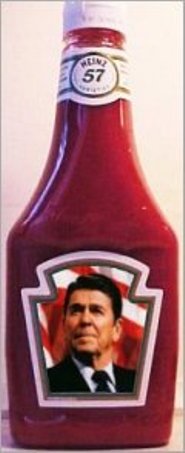

Ketchup took the sixth spot on Corn's lengthy list.
It looks like David Corn and all those angry, spiteful libs that have spent a quarter of a century criticizing President Reagan for the ketchup thing have egg on their faces.